
Strengthening Rural Livelihoods and Resilience to Climate Change in Africa (GALILEO)
| Duration | 2025–2028 |
| Funding agency | European Union under Grant Agreement No. 101181623. |
| Project sites | Senegal, Kenya, Ghana, Cameroon |
| Partners | CIRAD (lead), IRD, Q-Plan, INRAe, Wageningen University, Kobenhavns Universitet, Nitidae, Max Havelaar France, Terre Verte, Inst. Senegalais de Recherche Agricole, Centre de Suivi Ecologique, Conseil National de Concertation et de Coopération des Ruraux, Jardins de Afrique, University of Embu, ICIPE, Farm Africa, University of Ghana, IITA, Nature Conservation Research Centre, Kuapa Kokoo Cooperative, Inst. de Recherche Agricole pour le Developpement, Association Green Development Advocates, FiBL - Research Institute for Organic Agriculture |
| Project website | www.galileo-project.eu |
Overall objective
GALILEO focuses on the research and implementation of context-specific, people-centered agroforestry innovations in representative agro-pastoral, agroforestry, and agro-silvo-pastoral systems (AFSPs) of Sub-Saharan Africa (SSA).We use Multi-Actor Approaches to co-identify promising management scenarios, test them in different environments and develop recommendations for dissemination. GALILEO covers 8 Living Labs in semi-arid zones of Senegal and Kenya as well as humid but drought-prone zones of Ghana and Cameroon.
LUCIA modelling
LUCIA model development and simulations are conducted within WP6, focusing on soil-plant-livestock modelling. We concentrate on three sites in Sénégal and Kenya.
- Niakhar represents an agricultural site in the Senegalese groundnut basin; the main crops (groundnut, millet, cowpea) are grown in Faidherbia parklands with grazing during the dry season. Arriving at sustainable livestock densities and improving soil fertility are challenges in the area. LUCIA modelling will focus on the Faidherbia-crop systems aiming at capturing the reverse phenology of Faidherbia determined by groundwater access of deep roots.
- Ouarkhokh is a semi-arid site in the Senegalese Ferlo dominated by cattle and sheep / goat keeping. Agricultural crops are millet and groundnut, grown between Balanites sp., Acacia spp. and other native trees; livestock herding includes transhumance and local herd movement. We will expand the LUCIA-LivSIM coupling including the LivSIM-shoat module and an improved herd movement module.
- Embu is located on the slopes of Mt. Kenya, has two rainy seasons / year and is characterised by diversified agricultural systems including fruit trees and small-scale livestock keeping. Multi-purpose woody legumes for enhanced livestock productivity, reduced deforestation are important scenarios. LUCIA will be used to explore opportunities of diverse agro-silvo-pastoral systems (with maize as main crop).
Apart from the extended LUCIA-LIVSIM coupling the new LUCIA includes multiple soil horizons that can be initialised from databases like SoilGrids or ISDA.
Legume-based agroecological intensification of maize and cassava cropping systems in sub-Saharan Africa for water-food-energy nexus sustainability, nutritional security & livelihood resilience (LEG4DEV)
| Duration | 2020–2025 (EU-funded period: November 2020–October 2025). |
| Funding agency | European Union, through the DESIRA programme and the European Commission’s Directorate-General for International Partnerships (DG INTPA). |
| Partner institutions | University of Galway (lead), Wageningen University and Research (WUR), Swedish University of Agricultural Sciences (SLU), University of Hohenheim (UHOH), International Maize and Wheat Improvement Center (CIMMYT), International Livestock Research Institute (ILRI), and International Institute of Tropical Agriculture (IITA) |
| Project sites | Sub-Saharan Africa with particular emphasis on Ethiopia, Malawi, Tanzania, and Zambia as target countries |
Rationale and scope
LEG4DEV supports the scaling of legume-based agroecological intensification within smallholder maize and cassava cropping systems across Sub-Saharan Africa (SSA). The research activity at the University of Hohenheim (UHOH) addresses a central scientific question: How can crop models help design, evaluate, and scale productive, resilient intercropping systems under different environments and climatic conditions in Africa?
To answer this question, we introduce a new intercrop module for the spatially distributed dynamic Land Use Change Impact Assessment tool (LUCIA). This tool supports the scaling of legume-based agroecological intensification within smallholder maize and cassava cropping systems across Sub-Saharan Africa (SSA), delivering data-driven farming strategies tailored to localized climates to optimize the water-food-energy nexus and build long-term livelihood resilience.
Main modelling findings
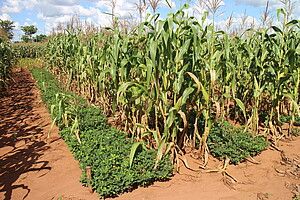
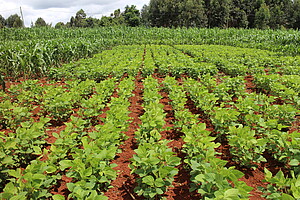
The LUCIA-Intercrop module dynamically simulates crop growth, light interception, and overall field productivity from individual fields up to broad landscape scales. Designed to accommodate different spatial arrangements and various species mixtures, the module was thoroughly evaluated using real-world field data on maize–grain legume intercrops collected in northern Ghana. The validation results confirm that the module reliably simulates intercrop growth, light interception, and productivity across these diverse systems using sole crop parameters only (Figure 2).
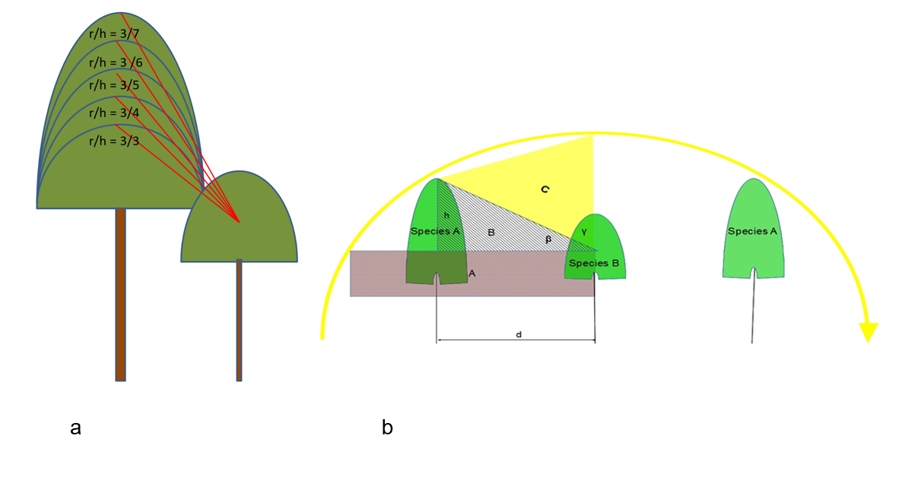
Figure 1. Light sharing approach in LUCIA-Intercrop module
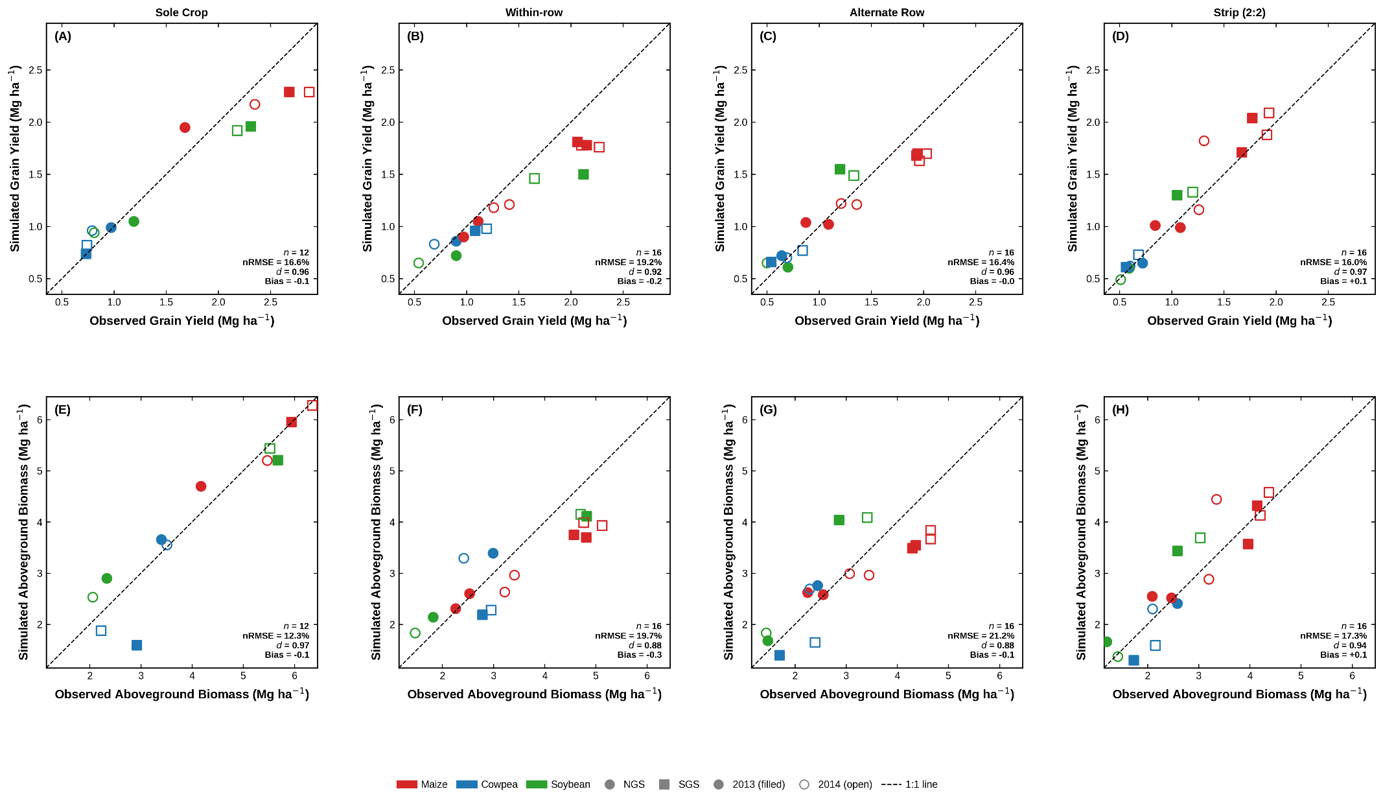
Figure 2. Observed versus simulated grain yield (A–D) and aboveground biomass (E–H) for sole-crop and intercrop treatments (Within-row, Alternate Row, and 2:2 Strip) across two growing seasons (2013, 2014) and two agroecological zones (NGS, SGS) in Ghana. Markers indicate species (Red: Maize; Blue: Cowpea; Green: Soybean) and zones (Circle: NGS; Square: SGS), with filled markers representing 2013 and open markers representing 2014. Dashed line indicates the 1:1 reference.
Synergistic use and protection of natural resources for rural livelihoods through systematic integration of crops, shrubs and livestock in the Sahel (SustainSAHEL)
| Duration | September 2020 – August 2025 (Five years) |
| Funding agency | European Union's Horizon 2020 Sustainable Food Security Programme under Grant Agreement No. 861974. |
| Project website | www.sustainsahel.net |
| Project sites | West African Sahel: Senegal (Niakhar, Ouarkhokh, Koussanar); Mali (Koulikoro, Sikasso); Burkina Faso (Saria, Yilou, Kamboinse) |
Rationale and background
Agricultural production in the West African Sahel faces significant challenges due to declining soil fertility, erratic rainfall, land degradation, and increasing climate variability. Sustainable intensification strategies that integrate crops, native shrubs, and livestock offer potential to enhance both productivity and resilience. Assessing the long-term impacts of these strategies across diverse environments requires process-based modelling.
Scope and research questions
The LUCIA model was employed to evaluate the long-term effects of crop-shrub-livestock integration on soil fertility, crop productivity, soil organic matter, and nutrient cycling under varying climate and management scenarios in the Sahel.
Research questions:
- How do native shrubs influence crop productivity under varying climatic conditions?
- What are the long-term impacts of shrub residue management on soil organic carbon and nutrient dynamics?
- Which crop-shrub-livestock systems are most resilient under future climate scenarios?
- How can process-based modelling support scaling sustainable intensification across the Sahel?
Main modelling findings
- LUCIA successfully simulated crop growth, soil water balance, nutrient cycling, and soil organic matter dynamics across contrasting Sahelian environments.
- Integration of shrubs improved long-term system resilience primarily through enhanced nutrient recycling and improved soil water use.
- Combined organic and mineral nutrient management produced higher and more stable crop yields than either input alone.
- Climate change scenarios projected yield reductions under high-emission pathways, emphasizing the need for climate-resilient management strategies.
- Spatial suitability analyses identified priority areas where crop-shrub-livestock integration is likely to provide the greatest benefits.
- Integrated systems (trees + crops + livestock) improve productivity, but crop yields depend heavily on nutrient inputs (manure + fertilizer).
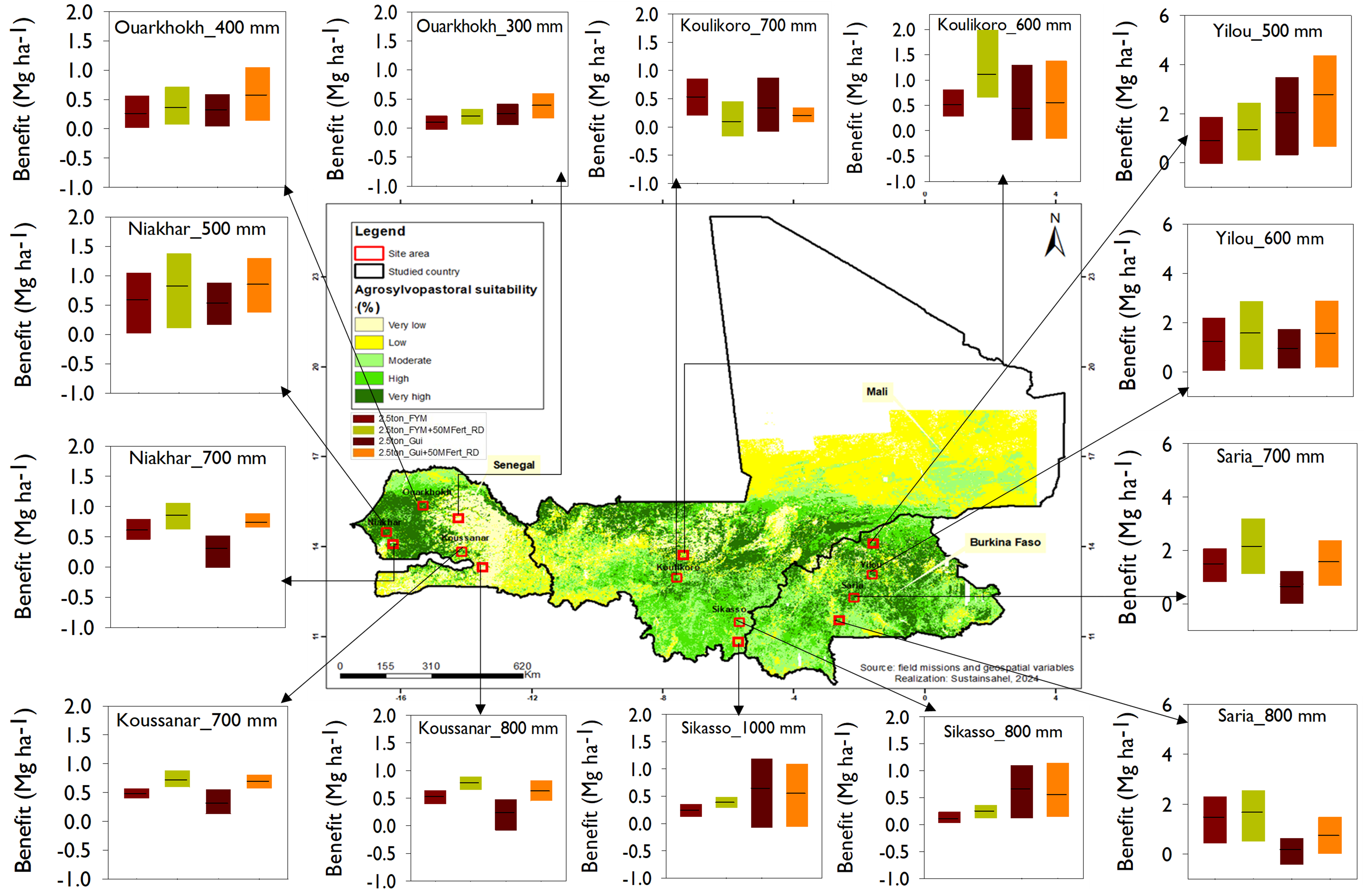
Figure 1. Simulated grain yield benefits of amendments with farmyard manure (FYM) and Guiera senegalensis residues, with or without 50% of the recommended dose (RD) of mineral fertiliser, for Millet in Senegal, Mali, and Burkina Faso under varying isohyets. The dashed horizontal line in the middle of the box plot indicates the mean across six years of simulation from 2018 to 2023. Simulated yield benefits from organic amendments align with mapped agrosilvopastoral suitability, with higher gains in regions identified as favourable (e.g., Niakhar, Koulikoro, Yilou). While high rainfall often improves yields (1.2–2.5 Mg/ha), other factors such as soil fertility, nutrient availability, and temperature play significant roles, especially in drylands.
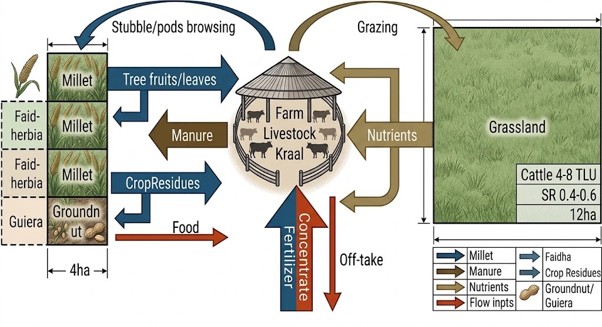
Figure 2. Illustration of internal resource flows and trade-offs across a farmscape-level agrosilvopastoral system in Niakhar, Senegal. Croplands with millet, groundnuts, and Faidherbia albida/Guiera senegalensis trees yield food, crop residues, and fodder pods. Crop residues and native grasslands feed livestock, which produce manure to replenish cropland soil nutrients. Animal off-take leaves the system, while dry-season concentrates and mineral fertiliser serve as external inputs. All resource flows are restricted to on-farm and grassland production, except in target intensification scenarios. Simulated scenarios capture interactions within a mixed crop-tree/shrub-livestock farming system, highlighting the use and reuse of organic resources across land and animal components. Thus, scenarios include on-farm organic resources only, intensification systems, and those with external inputs.
Underutilized or unprotected? New methods for analyzing diverging perspectives on the large-scale conversion of tropical grassland ecosystems
| Duration | Duration: 1.2.2016 – 31.9.2019 |
| Funding agency | Hans Freiherr von Ellrichshausen'sche Stiftung |
| Project site | Borana plateau, Ethiopia |
Overall objectives
(i) analyze biophysical, socio-economic, and governance processes in grassland ecosystems that are subject to land use transformation; (ii) to develop on this basis an integrated modeling system that makes it possible to assess different land use change scenarios (with a time horizon of up to 20 years), especially regarding their impact on the socio-economic system and the ecosystem services that grasslands provide; and (iii) to identify and analyze governance processes and instruments by which changes of land use in grassland ecosystems can be influenced.
LUCIA modelling
The "Ellrichshausen Project" was the basis for development of the LUCIA grassland module, which contains dormancy and reserve pools in savannah plant species, implementing a source-sink concept.
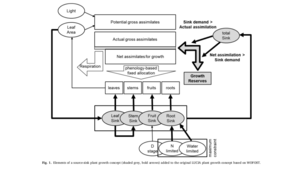
Fig. 1: Warth et al. 2021: Source-sink concept (shaded grey, bold arrows) added to the original LUCIA concept (based on WOFOST).
The amended LUCIA model was coupled to MPMAS (for herders' decision making) and the Livestock Simulator LIVSIM, so that interactions between humans, animals, soils and plants can be represented.
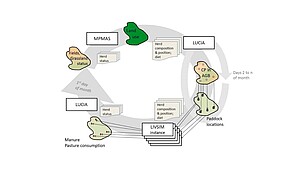
Fig. 2: Marohn et al. 2022: LUCIA coupled to LIVSIM and MPMAS
Sustainable Rubber Cultivation in the Mekong Region: Development of an integrative land-use concept in Yunnan Province, China (SURUMER)
| Duration | 01.12.2011 – 30.06.2017 |
| Funding agency | Federal Ministry of Education and Research of Germany (BMBF), Support Code (FKZ): 01 LL 091. |
| Partner institutions | University of Hohenheim, University of Stuttgart, Leibniz University of Hannover, Humboldt University Berlin, Kunming Institute of Botany, World Agroforestry Centre, East and Central Asia |
| Project sites | Southern tropical regions of China, especially Yunnan |
| Project website | SURUMER project website |
Rationale and background
The expansion of rubber plantations in southern tropical regions of China and its neighboring countries of the Mekong region has been predominantly realized by sacrificing natural forest belonging to the “Indo-Burma hotspot”, one of the world’s richest biodiversity regions. This rapid process triggers shifts in a variety of direct and indirect effects on ecosystem functions and services as well as socio-economic implications on various spatial and temporal scales. The complex and interrelated factors thereof require qualitative and quantitative analyses of ecosystem functions and services for the development of new and sustainable land use concepts.
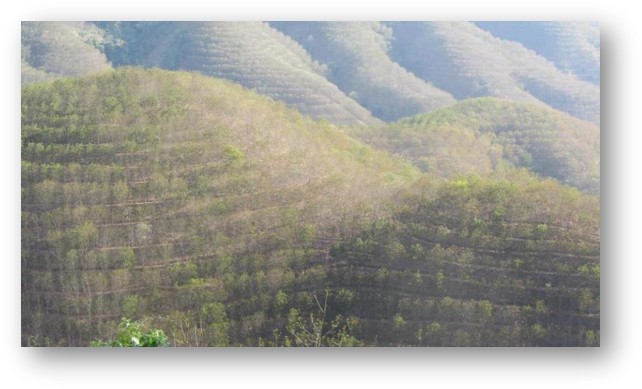
Photo 1. Rubber monocrop plantations in Xishuangbanna at end of dry season.
Scope and research questions
The overall objective of SURUMER is to develop an integrative, applicable, and stakeholder-validated concept for sustainable rubber cultivation in Yunnan. The concept is based on multi-, inter- and transdisciplinary approaches to identify trade-offs and synergies between ecosystem functions and services on the one hand and socio-economic goals and constraints on the other.
LUCIA was employed in the subproject ‘Carbon dynamics in different land use systems’. Experimental analysis and model simulations included the assessment of the impact of intensified rubber cultivation on spatial and temporal plant and soil carbon dynamics, inclusive gaseous flows from soil to the atmosphere in rubber plantations of different age and of natural forest. Additionally, soil erosion and associated sediment carbon and nutrients transport in overland flows within different watersheds and into major rivers were assessed. These data were used to improve and validate the LUCIA model as a tool for evaluating current and alternative land use systems on short and long-term effects on environmental services, to assist planning agencies and to promote interactions with local stakeholders.
Main modelling findings
Rubber plantations have expanded into regions with sub-optimal growth conditions with distinct dry seasons and temperatures cooler than in humid tropics. To improve our understanding of rubber trees response to planting at high altitudes we calibrated the process-based LUCIA tool with detailed ground survey data from Xishuangbanna, southwest China (Figure 1 left). Four greenhouse gas emission scenarios, with Representative Concentration Pathways (RCP) ranging from the lowest RCP 2.6 to the highest emission scenario RCP 8.5, were used to test rubber tree response to climate change.
During a 40-year rotation under current climate, lowland rubber plantations grew faster and had larger latex yields than highland rubber. The average biomass of lowland rubber was 9% and 18% higher than those of highland rubber for aboveground and belowground biomass, respectively. The results of the RCP 8.5 climate change scenario suggested that simulated 40 years mean total biomass and cumulative latex yield of highland rubber (per tree) increased by 28% and 48%, while lowland rubber increased by 8% and 10% respectively when compared to the baseline (Figure 1 right). The results could help in the development of future climate change adaption and mitigation strategies.
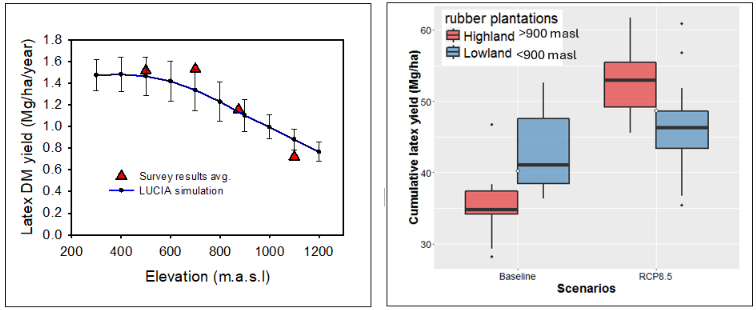
Figure 1. Effect of elevation on rubber latex yield under current (right figure and baseline left figure) and future (worst case RCP8.5) climate change scenarios (Yang et al. 2019).
Weed management and erosion
In order to assess the long-term effects of herbicide application on erosion in rubber plantation, we used LUCIA in simulating weed management effects on erosion in rubber plantations and associated sediment transport in rivers in the watershed.

Photo 2. Herbicide clean weeding or mechanical reduced weeding in rubber plantation.
Based on simulation results of 20-y runs we concluded that “once-weeding” and “no-weeding” both efficiently controlled soil loss in one rubber rotation length. But high surface and weed cover (over 95% and 60% respectively) under the “no-weeding” scheme suggested that with its dense undergrowth, it would be hardly acceptable by local farmers due to their concerns of potential danger from poisonous centipedes.
“Once-weeding”, on the other hand, controlled overgrowth of understory vegetation by keeping weed cover below 50%. The treatment further reduced sediment load (Photo 3) in surface waters, which are locally used for drinking water, by 15% (Figure 2).
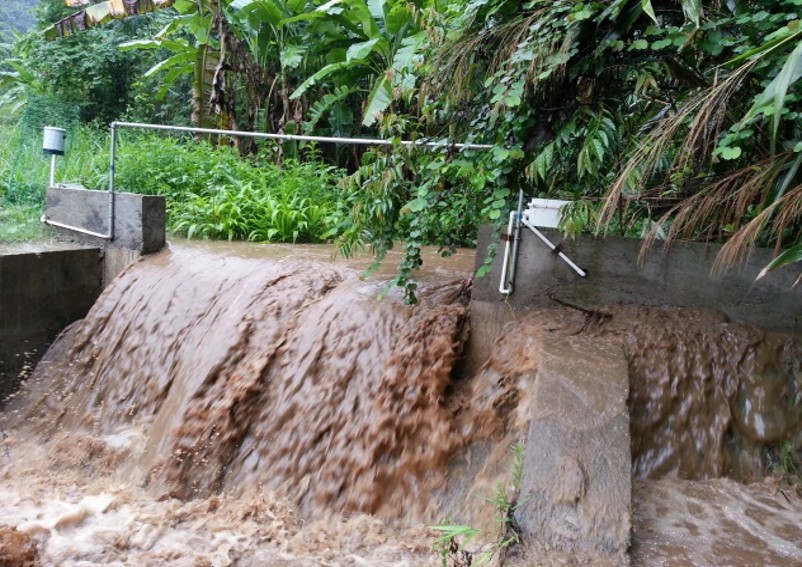
Photo 3. Sediment discharge from watershed during heavy rainfall.
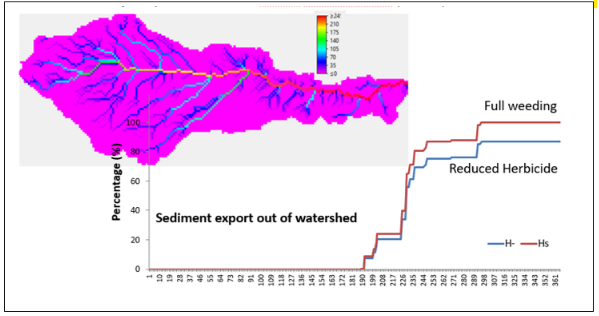
Figure 2. LUCIA simulated sediment yield patterns under different upstream rubber plantations at the outlet of the NNR Huilao subwatershed, Yunnan, China (adopted from Liu et al. 2020).
We therefore suggest “once-weeding” as improved herbicide management in rubber plantations to meet ecological system service maintenance and which could be easily adopted in practice.
Related publications
Yang, X., Blagodatsky, S., Marohn, C., Liu, H., Golbon, R., Xu, J., Cadisch, G. (2019). Climbing the mountain fast but smart: Modelling rubber tree growth and latex yield under climate change. Forest Ecology and Management, 439, 55–69.
Liu, H., Yang, X., Blagodatsky, S., Marohn, C., Liu, F., Xu, J., Cadisch, G. (2019). Modelling weed management strategies to control erosion in rubber plantations. Catena, 172, 345–355.
Liu, H., Yi, Y., Blagodatsky, S., Cadisch, G. (2020). Impact of forest cover and conservation agriculture on sediment export: A case study in a montane reserve, south-western China. Science of the Total Environment, 702.